

In the first part of this article, we learned to identify what a conflict is and how we usually react to it. However, knowing the problem is only half the battle. Conflict resolution—or, when that is not possible, the most beneficial management for everyone—is where the real challenge and opportunity lie.
Successful conflict resolution begins with the goal of moving from a “battlefield” to a common project. To achieve this, it is necessary to change the focus: stop seeing the other person as an opponent and start seeing them as an ally in building a “we.”
Mindset Shift: From Reaction to Responsibility
Furthermore, before attempting to resolve any dispute, we must adjust our perspective. It is about “stepping back from the wall” to see the full picture. In other words, “going to the balcony” to see with clarity from an appropriate height what is actually happening.
- From Mindfulness to Presence: Beyond relaxation, it is about focusing on what matters. For many, this involves recognizing a transcendent dimension that brings serenity. For a Christian, awareness focused on the essential opens the doors to discovering a God who is close and shares our daily journey.
- The Power of the Team: As in daily life, the team always surpasses the individual. For example, when a dishwasher breaks down in a large family, there are two possibilities. First, dirty dishes accumulate. Second, family members agree to wash them together, distributing tasks. Consequently, the work is finished better and faster than with the machine, proving that shared responsibility drives success.
The 5 Principles of Effective Conflict Resolution
Effective management, which in many cases leads to conflict resolution, relies on five pillars. Before starting the practical steps, we must establish these five fundamental convictions:
- “We,” not “Me against You”: We work together to manage differences, not to cancel the other person.
- The Forest, not just the Branch: The current problem is only one part of a much broader global relationship.
- Prioritize the Relationship: A solution that destroys the bond is not a real solution.
- Mutual Benefits: For an agreement to be stable, a need or value of both parties must be satisfied.
- Building vs. Negotiating: It is not about “haggling” until someone gives in, but about knowing each other to create something new.
Dudley Weeks’ 8 Steps for Conflict Resolution
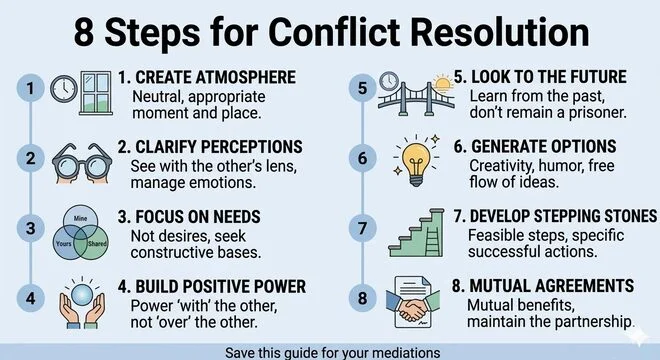
According to expert Dudley Weeks, we can follow a structured roadmap to achieve conflict resolution, or at least peace, in any environment. These steps are useful in families, classrooms, or corporate boardrooms.
| Step | Key Action |
|---|---|
| 1. Atmosphere | Choose the right time and a neutral place. |
| 2. Perceptions | Distinguish preferences from non-negotiable values. |
| 3. Needs | Ask directly: “What do you need?”. |
| 4. Positive Power | Move from “power over” to “power with” others. |
| 5. Future | Learn from the past without being its prisoner. |
| 6. Creativity | Generate “feasible” options without judging. |
| 7. Stepping Stones | Implement small acts with high probability of success. |
| 8. Agreements | Build mutual commitments and lasting partnership. |
1. Create the Right Atmosphere
The setting of a conversation is as important as the painting. It is vital to choose a time without exhaustion and a neutral place. A walk in nature or a round table can work wonders.
2. Clarify Perceptions
Everyone sees reality through their own lens. Ask yourself: What is a preference and what is a non-negotiable value? Pro tip: Learn to breathe deeply when you feel your emotional “locomotive” accelerating.
3. Focus on Needs
Do not confuse desires with needs. Ask directly: “What do you need for this to go well?” Identifying shared needs provides the building blocks for an agreement.
4. Build Shared Positive Power
Negative power seeks to “gain an advantage.” On the other hand, positive power seeks the ability to act effectively together—moving from “power over” to “power with.”
5. Look to the Future by Learning from the Past
Do not remain a prisoner of labels or “the way it has always been done.” Use the past to understand the origin, but put your energy into what can be done today and tomorrow.
6. Generate Creative Options
Use your imagination! Before deciding, list “feasible” options without judgment. Humor is also a powerful tool for unlocking stagnant situations.
7. Develop Feasible Stepping Stones
Do not seek an immediate total solution. Implement simple acts with a high probability of success. In short, it is better to build a small bridge of logs than to try to jump the abyss in one go.
8. Mutually Beneficial Agreements
Replace demands with commitments. These agreements must clarify responsibilities and, above all, keep the “partnership” alive.
Conclusion: The Value of Mediation
In conclusion, sometimes emotional noise is so loud that we need an external mediator (an objective third party or, on a spiritual level, God’s help) to see clearly. Conflict resolution through maturity not only solves a specific problem but improves our quality of life.
What “feasible stepping stone” could you take today? Conflict resolution is not an exact science, but a habit cultivated with patience.
Wenceslao Vial
See: Dudley Weeks’s book





0 Comments